
Sleeve Anchor vs Wedge Anchor: Choosing the Right Concrete Fastener
When you're standing in the hardware aisle staring at a wall of fasteners, the choice between a sleeve anchor and a wedge anchor can seem confusing. But it really boils down to two simple things: what you're drilling into and how much weight it needs to hold. A wedge anchor is your heavy-hitter, a specialist designed only for solid concrete when you need serious structural strength. On the other hand, a sleeve anchor is the versatile all-rounder, perfect for medium-duty jobs in concrete, brick, and even hollow block.
Comparing Key Differences in Sleeve and Wedge Anchors
Picking the right anchor isn't just a minor detail—it's fundamental to the safety, stability, and lifespan of your project. Whether you're a weekend warrior putting up a new deck or a pro contractor setting fence posts, knowing how these two fasteners actually work is the first step to a rock-solid installation. One gives you immense holding power in a very specific material, while the other offers flexibility across different surfaces.
This guide will break down what you actually need to know, helping you choose the perfect anchor without the guesswork. We’ll get into how they function, their performance capabilities, and the best situations to use each one.
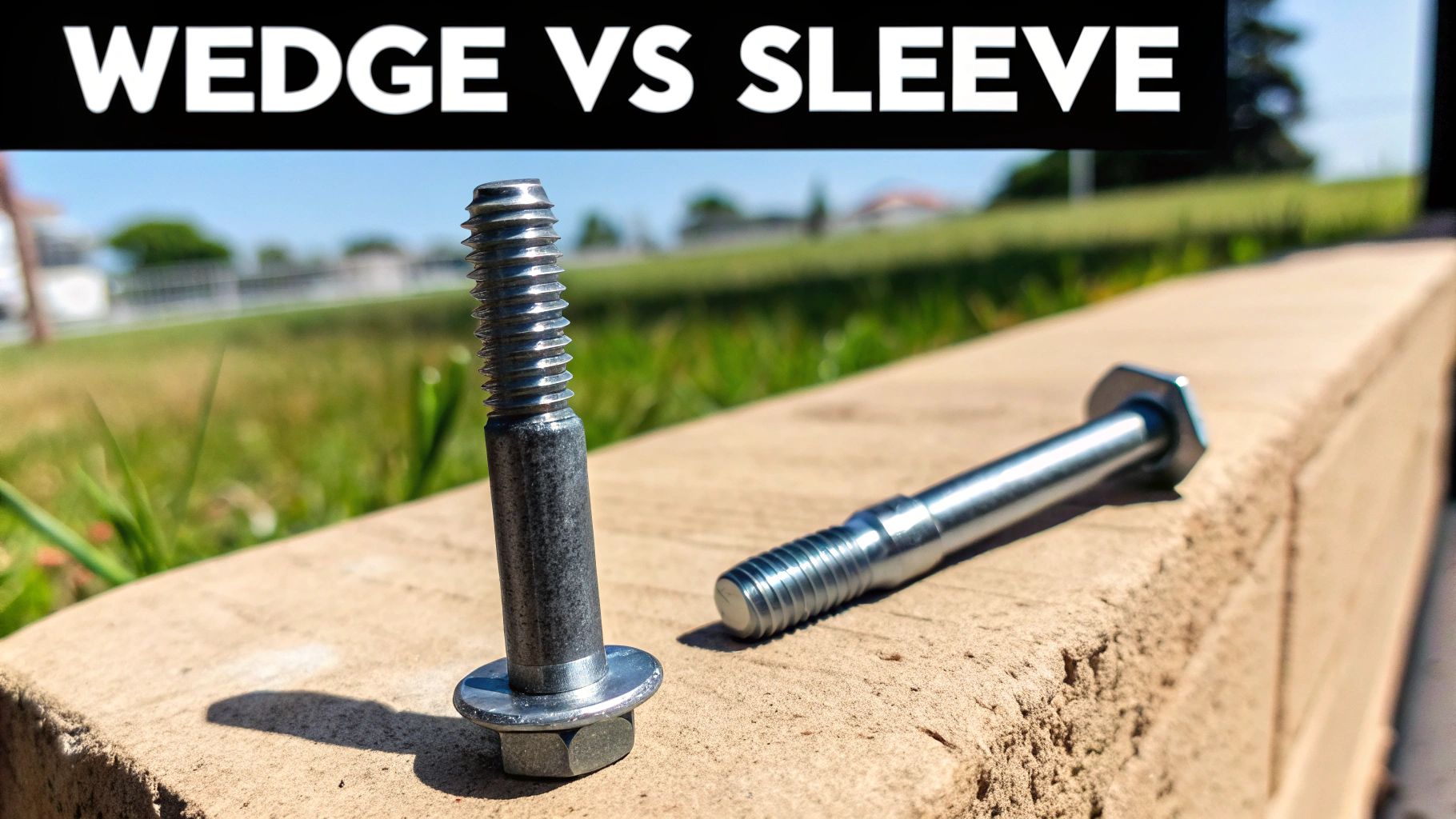
Wedge Anchor vs. Sleeve Anchor At a Glance
Let's start with a quick side-by-side summary. This table cuts right to the chase, highlighting the core differences you need to consider before you buy.
| Attribute | Wedge Anchor | Sleeve Anchor |
|---|---|---|
| Primary Use | High-strength fastening in solid concrete | Medium-duty fastening in concrete, brick, and block |
| Base Material | Solid concrete only | Solid concrete, brick, hollow block, concrete block |
| Load Capacity | High tensile and shear strength | Medium tensile and shear strength |
| Mechanism | An expansion clip wedges against concrete | The entire sleeve expands 360 degrees |
| Ideal for Decks | Securing ledger boards, post bases, structural elements | Attaching non-structural elements like handrails |
| Ideal for Fences | Anchoring heavy gate posts or structural supports | Fastening lighter fence panels or decorative hardware |
If you remember one thing, make it this: Never use a wedge anchor in brick or block. Its powerful, focused expansion force is too aggressive for these materials and can easily crack or shatter them, leading to total failure.
This quick overview gives you the lay of the land, but now let's dig deeper. We’ll explore the engineering behind each anchor's grip, see how they perform under real-world stress, and walk through the proper installation steps. For any project, you can find a complete selection of both zinc-plated and corrosion-resistant fasteners at XTREME EDEALS INC. to handle whatever the Canadian weather throws at it.
How Each Anchor Actually Grips the Wall
So, you've got a sleeve anchor and a wedge anchor. They both expand, right? Well, yes, but how they expand is the whole ball game. It’s the key difference that dictates what you can fasten and where you can fasten it, and getting it wrong can mean a failed project down the line.
The fundamental distinction comes down to how each anchor creates its grip inside the hole. One uses brute, concentrated force, while the other takes a more distributed, versatile approach.
Wedge Anchors: Pure, Concentrated Force
Think of a wedge anchor as a specialist built for one job and one job only: getting an unbreakable grip in solid concrete. Its design is brutally simple—a threaded stud with a small expansion clip at the business end.
The real action starts when you crank down on the nut. As you tighten it, the threaded stud pulls upwards, forcing the tapered bottom end of the stud deep into that little expansion clip. This drives the clip outwards with incredible force, wedging it against the walls of the hole.
This creates a massive friction-fit. The anchor isn't just sitting there; it's actively trying to push the concrete apart, generating huge holding power in a very small area. This is exactly why wedge anchors are champions at handling both tensile loads (forces trying to pull it straight out) and shear loads (forces trying to push it from side to side).
- Tensile Strength: That intense friction makes it incredibly difficult to pull the anchor out. It’s perfect for heavy-duty jobs like securing a deck ledger board to a foundation wall.
- Shear Strength: The unyielding grip stops any side-to-side movement, which is critical when you're anchoring something like a fence post base that has to fight against wind.
But this intensity is also its Achilles' heel. That same focused power is far too aggressive for brittle materials like brick or any kind of hollow block. Try using one there, and you’re more likely to crack or completely blow out the material than to get a secure connection.
Sleeve Anchors: The Versatile 360-Degree Grip
The sleeve anchor, on the other hand, is the adaptable generalist. It works by spreading the load over a much larger surface area. Instead of a tiny clip doing all the work, the entire body of the anchor—the "sleeve"—expands to create the hold.
Here's how it works: a threaded bolt passes through a cylindrical metal sleeve. As you tighten the bolt head, it pulls a cone-shaped expander up into the sleeve. This forces the whole sleeve to flare outwards along its length, creating a full 360-degree pressure zone against the inside of the hole.
The pressure is much less intense at any single point compared to what a wedge anchor delivers.
Key Takeaway: Picture a wedge anchor's force like the tip of a nail—highly concentrated and powerful. A sleeve anchor's force is more like the palm of your hand—spread out and much gentler. This core difference dictates what you can safely drill into.
This gentler, broader expansion is what makes the sleeve anchor so incredibly versatile. It can get a secure grip in a whole range of base materials without the risk of destroying them.
- Solid Concrete: It works just fine for medium-duty tasks where you don't need the extreme strength of a wedge anchor.
- Brick and Block: This is where the sleeve anchor really shines. The gentle, all-around expansion won't crack delicate brick faces. In hollow block, the sleeve can expand to bridge the internal voids, creating a secure hold where a wedge anchor would find nothing to grab onto.
This adaptability makes sleeve anchors the go-to for jobs like fastening a handrail to a brick staircase or mounting a satellite dish on a block wall. While it can’t match a wedge anchor's raw power in solid concrete, its flexibility makes it a must-have for a huge variety of common projects.
For a full lineup of sizes in both anchor types, you can explore the options at XTREME EDEALS INC. to find the perfect fit for your specific material and load needs.
Comparing Performance for Demanding Deck and Fence Projects
When you move from paper plans to the real world of building decks and fences, the performance gap between sleeve and wedge anchors becomes a big deal. It's not just about how they grip the concrete; it's about how much force—both pulling up and pushing sideways—they can take before they fail. For any project that has to carry serious weight or stand up to mother nature, picking the right anchor is a matter of safety and structural integrity.
The whole decision boils down to two key specs: tensile strength (how hard you can pull it out) and shear strength (how much sideways force it can handle). A deck ledger board, for instance, is under massive shear force from the deck's weight. A tall fence post, on the other hand, has to fight tensile forces every time a strong wind tries to lift it out of the ground. This is where the wedge anchor’s heavy-duty design really shines.
Unpacking Tensile and Shear Strength
A wedge anchor gets its incredible holding power from a small expansion clip that bites into solid concrete with focused, immense pressure. This creates a friction grip that's extremely tough to pull out, giving it the high tensile strength you absolutely need for securing the foundational parts of a structure.
At the same time, its solid steel body delivers fantastic shear strength. If a car bumps a guardrail or a heavy object slams into a post, the wedge anchor is built to resist snapping. This one-two punch of high tensile and shear capacity makes it the only real choice for attaching structural pieces like deck post bases or ledger boards to a concrete foundation. Using anything less is just asking for trouble.
This chart gives you a quick visual on how the two stack up in terms of load capacity. It makes it pretty clear why one is built for high-stress jobs and the other is better suited for medium-duty tasks.
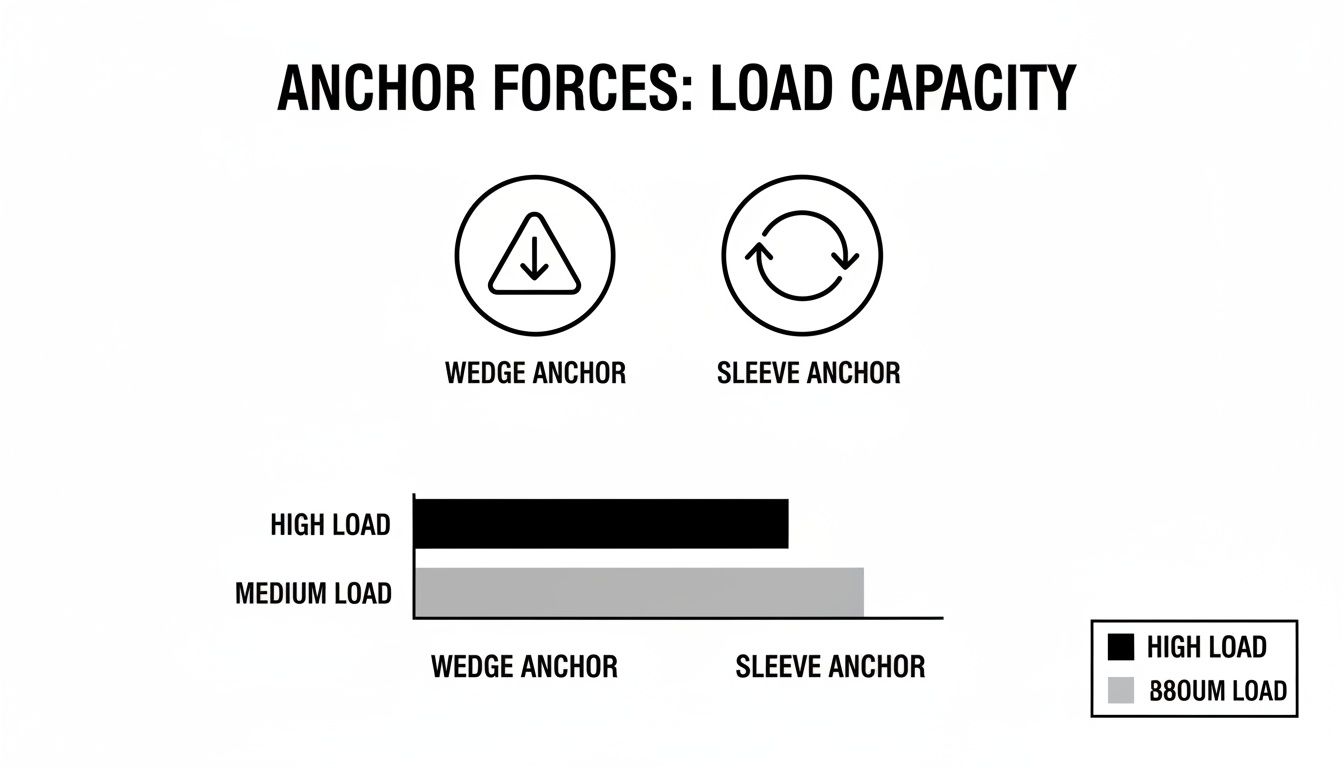
A sleeve anchor, with its sleeve expanding a full 360 degrees, spreads the load out over a larger area, but with less intensity. While this makes it really versatile, it does mean its ultimate strength is lower. It's more than enough—and often the perfect fit—for medium-duty applications. Think about attaching fence panels to a concrete wall, mounting gate hardware, or securing deck railings. These jobs aren't carrying the main structural load of the whole project. You can check out some great options in our guide on deck railing ideas, all of which can be safely installed with the right anchor.
Real-World Scenarios and Load Ratings
Look at the building codes in places that deal with a lot of environmental stress. In areas with seismic activity, engineers have relied on wedge anchors for heavy-duty construction for decades. A typical 1/2-inch wedge anchor can have an ultimate tensile strength of over 7,000 lbs in 4,000 psi concrete. That gives you a safe working load of around 1,750 lbs, which is roughly 55% higher than what you'd get from a sleeve anchor of the same size.
This is the kind of data that makes wedge anchors the go-to for securing post bases and joist hangers, especially in places like Ontario, where XTREME EDEALS is based, which can experience its own seismic shifts. Professionals count on wedge anchors to resist vibration from high winds or ground movement, preventing catastrophic failure.
Critical Safety Insight: Always, always choose your anchor based on its published load ratings, not just its size. A project's safety hinges on matching the anchor's tested strength to the actual loads it will face. Never swap in a sleeve anchor where an engineer or building code calls for a wedge anchor. The risk just isn't worth it.
Choosing from the XTREME EDEALS INC. Product Line
At XTREME EDEALS INC., we carry a full lineup of both anchor types for exactly these reasons. Our product descriptions give you the specs you need to make the right call.
- For Structural Connections: If you’re attaching ledger boards, support posts, or anything else that carries the main weight of your structure, our Wedge Anchors are what you need. They’re designed to meet and beat building code requirements for structural safety.
- For Medium-Duty Fastening: When you’re mounting railings, gate hinges, or other non-structural fixtures, our Sleeve Anchors offer a dependable and flexible solution that works in a variety of base materials.
By understanding the performance numbers, you can get past the simple "sleeve vs. wedge" debate and make a smart decision that ensures your deck or fence isn't just built to look good, but built to last—safely.
Comparing Base Material and Corrosion Resistance
Picking the right anchor goes way beyond just load capacity. It’s really about matching the fastener to the surface it’s going into and the environment it will have to survive in. An anchor’s performance is directly tied to its base material—what works perfectly in one scenario can lead to a catastrophic failure in another. This is the single most important rule when you’re debating sleeve anchors vs. wedge anchors.
Just as critical, especially for outdoor projects like decks and fences, is corrosion resistance. Ignoring this is just asking for rust, decay, and a fastener that fails long before it should. The finish you choose is every bit as important as the type of anchor.
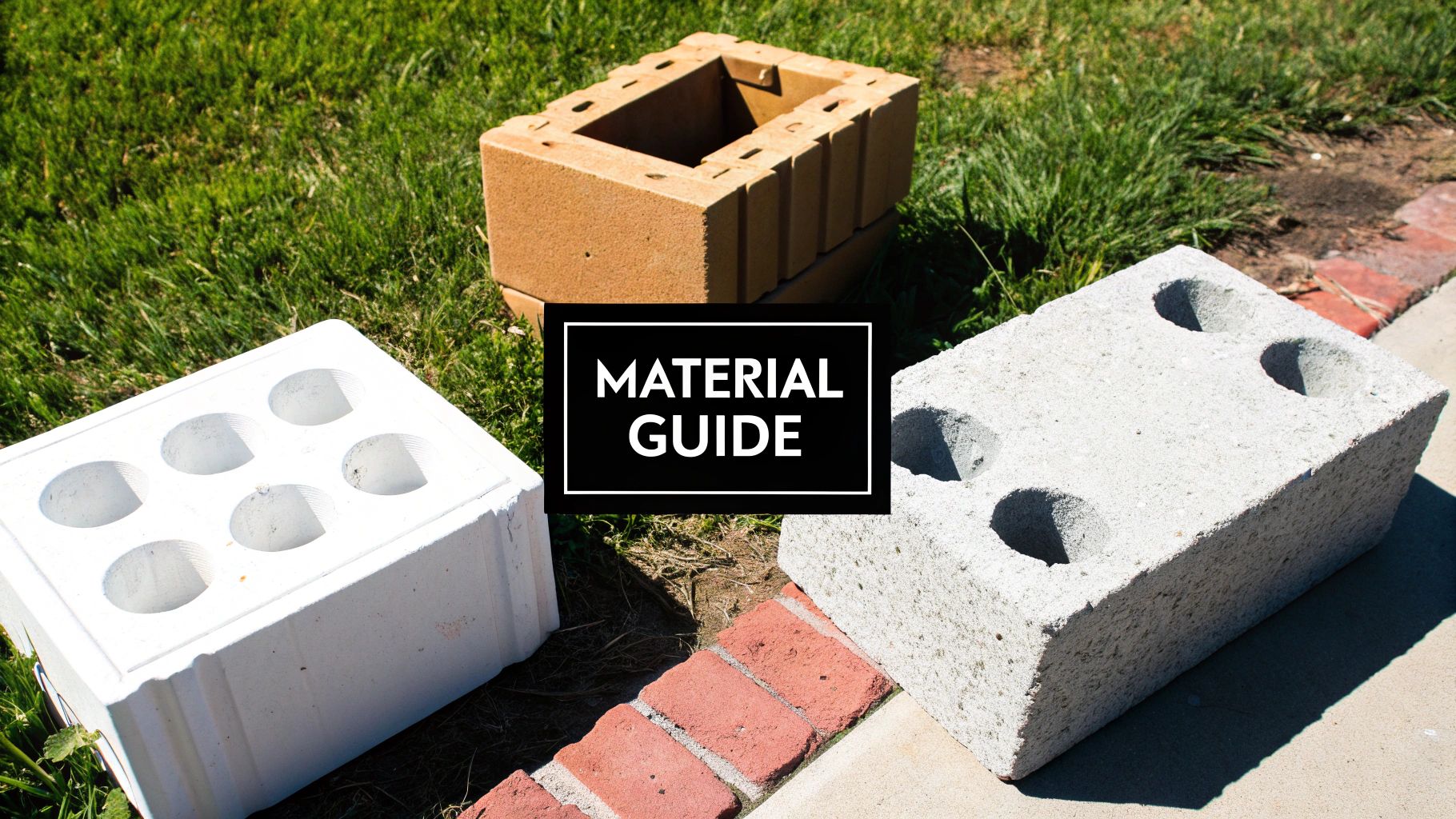
Base Material: The Non-Negotiable Rule
The biggest difference between these two fasteners comes down to the base material they’re made for. Let’s be clear: there is absolutely no wiggle room here.
Wedge anchors are designed for one thing and one thing only: solid, fully cured concrete. Their powerful expansion mechanism creates an intense, focused pressure point deep inside the hole. This immense force is what gives them such incredible holding power, but it will also easily crack, spall, or completely blow out the side of weaker materials like brick, hollow concrete block (CMU), or "green" concrete that hasn't cured yet.
On the other hand, sleeve anchors are the versatile choice for a much wider range of masonry. Their 360-degree expansion spreads the pressure out gently along the entire length of the sleeve, making them ideal for more delicate materials.
- Brick: The wider, more even pressure distribution won't crack the brittle face of a brick.
- Hollow Block: The sleeve is long enough to expand and bridge the hollow voids inside the block, creating a secure grip where a wedge anchor would find nothing to grab onto.
- Solid Concrete: They also work well for medium-duty jobs in solid concrete where you don't need the extreme load values of a wedge anchor.
The rule is simple: if you are drilling into anything other than solid, high-strength concrete, the wedge anchor is not an option. The sleeve anchor is your go-to fastener for brick, block, and other varied masonry surfaces.
Choosing the Right Finish for Corrosion Resistance
For any outdoor project in Canada—from a soggy Vancouver deck to a windswept Halifax fence—corrosion is a constant battle. The finish on your anchor determines how long it will last before rust compromises its structural integrity. At XTREME EDEALS INC., we stock options to handle every Canadian environment.
Zinc-Plated Anchors
This is your standard, most basic finish. Zinc plating offers a minimal layer of protection against rust and is only suitable for dry, indoor applications. Using a zinc-plated anchor outside, especially for anything structural, is a serious mistake that will lead to rapid corrosion and failure.
Hot-Dip Galvanized Anchors
For most outdoor projects, hot-dip galvanization is the recommended minimum. This process involves dipping the anchor in molten zinc, which creates a much thicker and more durable protective coating. It provides substantial rust resistance, making it an excellent choice for decks, fences, and pergolas exposed to rain and humidity.
Stainless Steel Anchors
When you need the absolute best protection, stainless steel is the only way to go. Available in different grades (like 18-8 or 316), stainless steel anchors are inherently rust-proof. They are essential for:
- Coastal areas where salt spray is in the air.
- Projects involving treated lumber, as modern wood preservatives can be highly corrosive to standard steel.
- Environments with exposure to chemicals or chlorine, like the area around a swimming pool.
Recent building trends show a clear shift towards more robust fasteners in demanding conditions. In California, for instance, wedge anchors now dominate sales for concrete fastening in decks and fences, largely driven by seismic codes that favour their high shear strength. This is relevant for us, too; a 3/4-inch wedge anchor can deliver 15,000 lbs of ultimate tension, a massive 58% advantage over a sleeve anchor's maximum. Pros prefer them for their vibration resistance, and stainless steel options, like the ones stocked by XTREME EDEALS, are specified to meet ASTM standards for wet climates, drastically reducing corrosion in foggy or humid regions. You can dig deeper into anchoring solutions for concrete from industry experts who have been tracking these developments for years.
Step-by-Step Installation Differences
Getting the installation right is where the rubber meets the road. It’s a game of precision, and each anchor type has its own set of rules. While you'll be drilling a hole either way, the small—but crucial—differences in procedure are what determine the anchor's final holding power and the safety of your project. Let's be clear: winging it is not an option.
The whole sleeve anchor vs. wedge anchor installation debate boils down to two key things: preparing the hole and the final tightening process. One is a bit more forgiving if you're not a seasoned pro, while the other demands perfection to deliver its full strength. Knowing these practical differences is the best way to avoid the common mistakes that can sink your entire project.
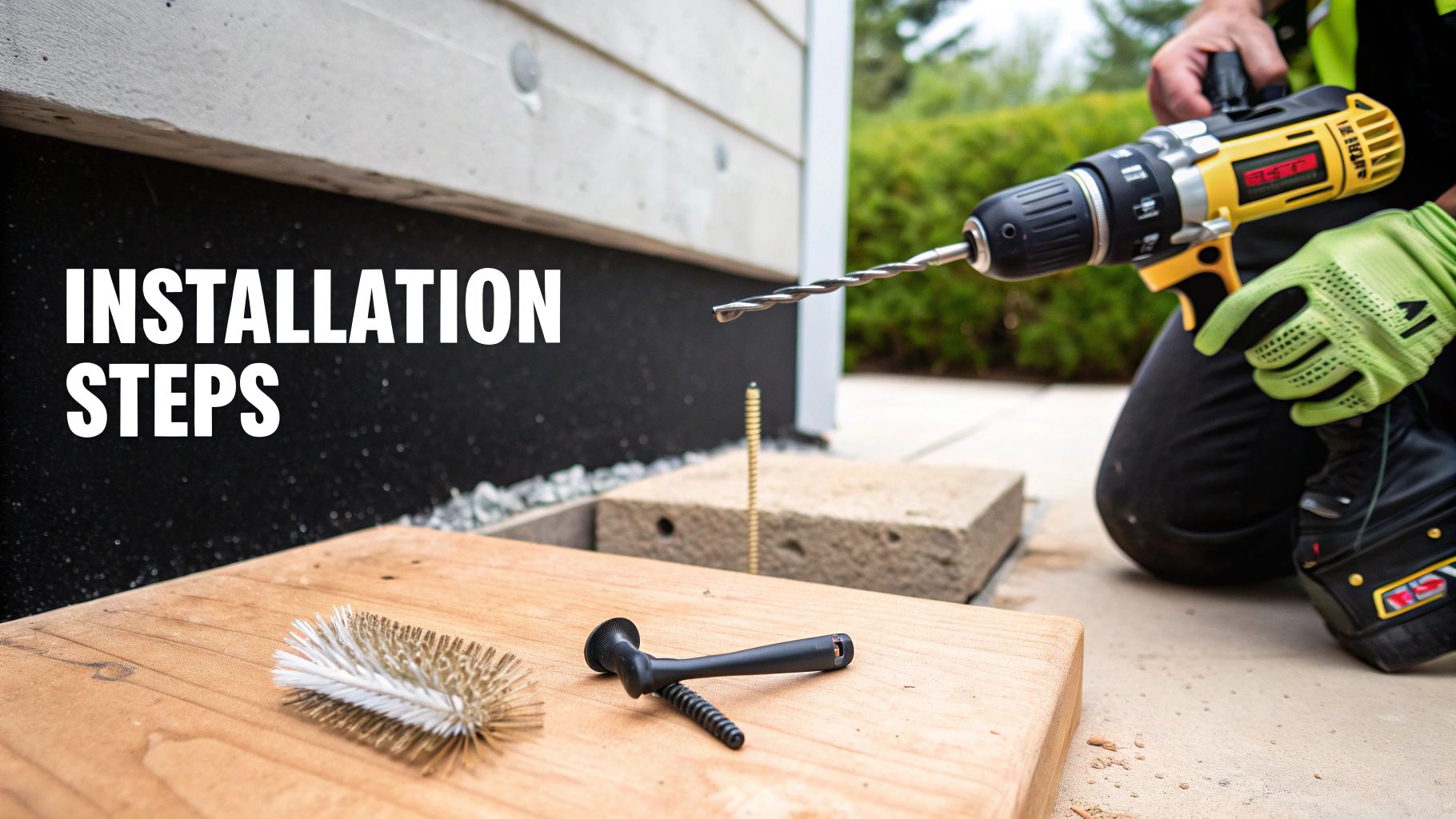
Drilling the Hole Correctly
Drilling is the first step for both, but this is where people often make their first mistake. The required hole size is completely different for each anchor.
- For a wedge anchor, the rule is simple: the hole diameter must be exactly the same as the anchor's diameter. If you have a 1/2" wedge anchor, you need a 1/2" hole. This creates the tight, friction-based fit it needs to work.
- For a sleeve anchor, the hole must match the outer diameter of the sleeve, not the bolt. This means the hole will be larger than the bolt size. For instance, a 3/8" sleeve anchor (which refers to the bolt) might require a 5/8" hole. Always double-check the manufacturer's specs on the box.
Using the wrong drill bit is a classic rookie error. A hole that’s even slightly too big for a wedge anchor means it will never grip properly. Trying to force a sleeve anchor into an undersized hole will just damage the sleeve and make it useless.
Hole Cleaning: The Critical Wedge Anchor Step
Once the hole is drilled, the next step is what truly separates these two. For a wedge anchor, cleaning the hole isn't just a suggestion—it's absolutely essential for it to reach its rated load capacity.
A wedge anchor relies entirely on its small expansion clip digging into the concrete. If that hole is full of dust, the clip just bites into loose debris instead of solid material, which tanks its holding power. You have to clean the hole meticulously with a wire brush and compressed air, repeating until it's spotless.
I've seen it countless times: an installer skips cleaning the hole because the anchor feels tight when they set it. This creates a false sense of security. An anchor buried in dust might hold for a while, but it can fail under a fraction of its rated load when you least expect it.
Sleeve anchors are a bit more forgiving here. Because the entire sleeve expands along its length, there's a much larger surface area to create grip. A clean hole is always best practice, of course, but a little bit of leftover dust is far less likely to cause a catastrophic failure than it would with a wedge anchor.
Insertion and Tightening Procedures
The final steps of setting the anchor are also unique to each type. The mechanical action that creates the holding power is different, so the approach you take matters. For a clearer picture, let's break down the required steps and tools side-by-side.
Installation Checklist and Tool Comparison
This table outlines the distinct processes and equipment needed to properly install each anchor type.
| Installation Step/Parameter | Wedge Anchor Requirements | Sleeve Anchor Requirements |
|---|---|---|
| Hole Diameter | Must match anchor diameter (e.g., 1/2" anchor needs a 1/2" hole). | Must match sleeve's outer diameter (e.g., 3/8" bolt may need a 5/8" hole). |
| Hole Cleaning | Absolutely critical. Use a wire brush and compressed air until spotless. | Recommended. More forgiving, but a clean hole is always better. |
| Fixture Placement | Place fixture before inserting the anchor into the hole. | Place fixture before inserting the anchor into the hole. |
| Insertion Method | Tap gently with a hammer until the washer is snug against the fixture. | Insert by hand through the fixture and into the hole. |
| Tightening Tool | Torque wrench is mandatory. Do not use an impact driver. | Wrench is sufficient. A torque wrench is good practice but less critical. |
| Tightening Action | Tighten the nut to the specified torque. This pulls the shaft up, forcing the clip to expand. | Tighten the nut/bolt head. This pulls the cone up into the sleeve, causing it to flare out. |
The tools really tell the story. For any serious structural work involving wedge anchors, a torque wrench isn't just a good idea; it's a non-negotiable part of the job for safety and compliance. But if you're installing something like wall mounting brackets, especially into less predictable materials like brick, the sleeve anchor offers a much more straightforward and forgiving installation process.
Making the Final Choice for Your Project
Now that we’ve covered all the details, deciding between a sleeve anchor and a wedge anchor really comes down to a few straightforward questions about your specific job. You get it by now: one anchor offers brute strength in one specific material, while the other gives you reliable flexibility across several different surfaces.
Let's turn that knowledge into a clear, confident choice for your fence or deck project.
Think of it like this—your base material is the very first thing you need to consider. If you're drilling into anything other than solid, high-strength concrete, the decision is pretty much made for you.
Scenario-Based Recommendations
To make it even simpler, here are some direct recommendations for situations you're likely to run into:
- Securing a Deck Ledger to a Concrete Foundation: For this critical structural connection, a hot-dip galvanized Wedge Anchor is the only safe and code-compliant choice. Its massive shear and tensile strength are non-negotiable for holding up the immense weight of a deck. Don't even think about using anything else here.
- Attaching a Handrail to a Brick Staircase: This is a perfect job for a stainless steel Sleeve Anchor. Its gentler, 360-degree expansion provides a solid grip without the high stress that could crack the face of the brittle brick. Using stainless steel also means you won't see ugly rust stains running down your steps later on.
- Mounting Heavy Fence Posts on a Concrete Slab: To fight back against wind loads and keep your fence stable for the long haul, you need the high performance of our Wedge Anchors. Pair them up with sturdy Post Bases, and you'll create a foundation that will last for years.
The most critical takeaway is this: never, ever compromise on structural connections. A sleeve anchor is a fantastic fastener, but it is no substitute for a wedge anchor when you need maximum load capacity in solid concrete for safety.
Your Final Project Checklist
Before you head to the checkout, just run through this quick mental checklist. It'll guarantee you walk away with the right hardware for the job.
- What am I drilling into? Is it solid concrete, or is it brick, hollow block, or some questionable old masonry?
- What kind of load is it? Am I dealing with a heavy, structural load (like a deck ledger) or a medium-duty, non-structural attachment (like a gate latch)?
- What's the environment like? Is this for an indoor, dry spot, or is it an outdoor project that will get hit with rain, salt, or be in contact with treated wood?
Answering those three questions will point you straight to the right anchor. For a full selection of fasteners built for Canadian conditions, you can browse our Wedge Anchors and Sleeve Anchors at XTREME EDEALS INC. While you're there, you can also learn more about the finishing touches in our guide on how to buy post caps for your fence or deck.
Have More Questions? We've Got Answers.
Even the best-laid plans run into questions once the drill comes out. Here are a few of the most common things people ask when weighing sleeve anchors against wedge anchors. We've got quick, practical answers to get you past the head-scratching and back to work.
Can I Remove Sleeve or Wedge Anchors Once They're In?
Think of both anchor types as a one-way trip. Once a wedge anchor is set, that expansion clip bites into the concrete and it’s not letting go. The only way it's coming out is if you cut the bolt flush with the surface. Don't even bother trying to back it out.
A sleeve anchor is a bit more forgiving, but not by much. You might be able to back the bolt out and pry the sleeve from the hole, but you'll probably chew up the surrounding concrete, brick, or block in the process. It's really best to treat both as permanent, one-and-done fasteners.
How Perfect Does My Drill Hole Need to Be?
Precision is everything, but it means something different for each anchor.
With a wedge anchor, there’s zero wiggle room. The hole diameter has to be an exact match for the anchor diameter. If you have a 1/2-inch wedge anchor, you need a 1/2-inch hole. Period. If the hole is even a little too big, the expansion clip has nothing to grab, and your anchor is completely useless.
A sleeve anchor, on the other hand, needs a hole that matches the outer diameter of its sleeve, not the bolt inside it. This trips people up because the hole will always be bigger than the bolt size printed on the box. Always double-check the packaging for the right drill bit size. They're a bit more forgiving on hole depth, but getting the diameter right is non-negotiable.
Which Is the Right Anchor for Hanging a Heavy Shelf in My Garage?
This one comes down to what your garage walls are actually made of.
- Got Solid Poured Concrete? A wedge anchor is your ticket for maximum holding power. It’s probably overkill for a simple shelf, but if you're hanging something seriously heavy—like an engine block or a loaded tool chest—it gives you unmatched peace of mind.
- Working with Concrete Block (CMU)? This is an easy one: the sleeve anchor is the only correct choice. Its full-length, 360-degree expansion is specifically designed to grip securely inside both the solid webs and the hollow parts of the block. A wedge anchor just can't work in that kind of material.
No matter the project, having the right hardware isn't just about getting it done—it's about safety and building something that lasts. At XTREME EDEALS INC., we stock a complete lineup of high-quality wedge anchors, sleeve anchors, and all the fasteners you need to do the job right.
You can check out our full selection at https://www.xtremeedeals.ca.

